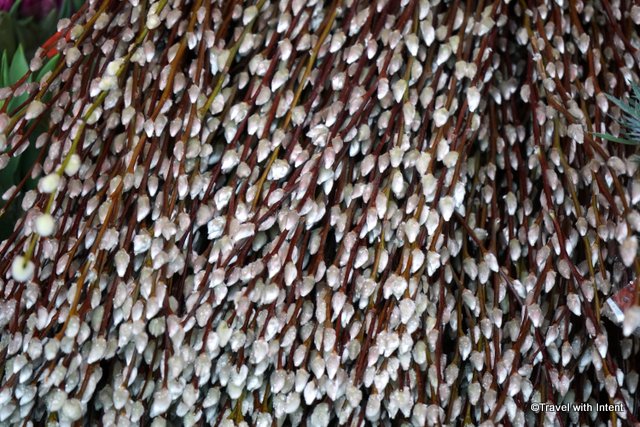
These delightful branches of pussy willow were on display at Columbia Road Flower Market when I visited in April. I adore these branches; they are a real sign of spring for me – and for many others I discover upon doing a spot of research.
The silk-like buds that cover the branches appeal to the Chinese apparently, who use them as a major display at Chinese New Year. In Northern and Eastern Europe and in America they are often used as a replacement for palm leaves (a practical issue rather than aesthetic, I think – palms don’t grow naturally that far north) on Palm Sunday. In Poland, it seems, the pussy willow is a part of their lively Easter Monday (Dyngus Day) celebrations, when boys throw water over girls they like and hit them with pussy willow branches. A strange seduction method, if you ask me!
The pussy willow has uses beyond decoration and spanking. Willow branches have long been used for weaving baskets and furniture, and even coffins. Back in the eighteenth century, and Oxfordshire man used ground willow bark to cure rheumatic pain and this eventually led to the development of aspirin. A more recent use is in biomass burning to generate electricity, for example at the Drax power station in Yorkshire.
The term pussy willow is actually used for a number of willow trees at this time of year – any that have this soft silver fluff before the catkins develop their green colour. Later in the year, once the fluff vanishes, they just go back to being known by their normal names, such as goat willow and grey willow. We are likely to suffer a bit of a shortage of willow in the UK this year: willows grow in wet ground, by rivers and lakes, but the massive floods this year have proved to much for many of them. In the Somerset Levels at least one willow farm was completely devastated after sinking below water.
I’ll now just leave you to enjoy their beauty.
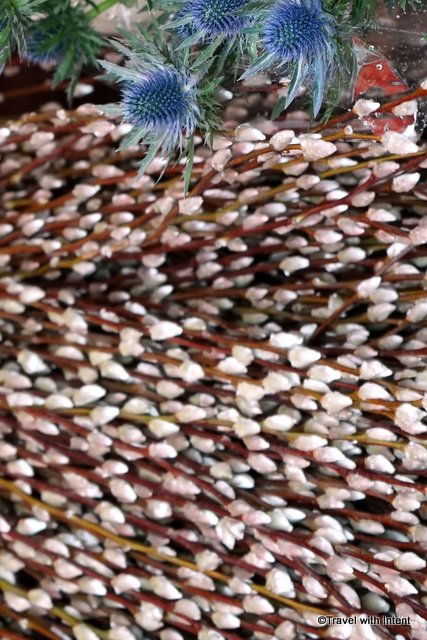
Columbia Road Flower Market, in East London, is open every Sunday, no matter the weather. The only exception is Christmas Day when it happens to fall on a Sunday. The flowers on display obviously vary by season, but you can always be assured of a vast selection of plants and cut flowers.


 Travel with Intent
I am really a fan of pussy willows. When I can find them, I add them to the bucket of similar stalks and flowers I keep in the living room. =)
LikeLike
They are quite hard to find. I shall be back at this market in the spring!
Sent from my iPhone
>
LikeLike
I always try and find a bunch of them to display in the Spring. So pretty!
LikeLike
So many of them!
LikeLike
Terrific post….the collection of the budded branches is beautiful♪ http://lauriekazmierczak.com/pixeled-park/
LikeLike
Wonderful post and great photos for P ~ Love the pussy willows!
artmusedog and carol (A Creative Harbor)
LikeLike
It`s great to read about these traditions all over the world! In Romania, religious people get pussy willow from church before Easter. It`s supposed to bring health and joy in the family.
LikeLike
Always liked these, especially to feel them.
LikeLike
All bunched together, makes very interesting pictures. These traditions are new to me.
Great read.
LikeLike
Such a wonderful sign of spring.
LikeLike
WOAH! I’ve never seen or heard of these! It would be awesome to visit some day. I wonder if they grow in the US.
LikeLike
Yes, you get them in US. You can even buy online here: http://www.nettletonhollow.com/Pussy-Willow-Branches-p/110600.htm For next year now though
LikeLike
I love Pussy Willow… always reminds me of my Grandmother
Mollyxxx
LikeLike
I love pussy willows. Thanks for all the information!
LikeLike
They remind me of a boom my daughters like very much were they are featured.
LikeLike
Wow, lots of interesting information about pussy willows that I did not know. My father-in-law loved them and always gave us some for dried arrangements. Someone had a lovely weeping on on their blog recently.
LikeLike
So so beautiful!!! Thanks for sharing the love up-close with I Heart Macro:-)
LikeLike
So pretty — Spring indeed!
Did not know about that tradition in Poland – haha!
🙂
Traci
LikeLike
I love pussy willows and the history lesson.
LikeLike
So beautiful! I’ve never seen these. They do look like silk buds! I enjoyed reading about the tradition around them. 🙂
Here from Sundays in my City.
LikeLike
I’m a big fan of pussywillows! Definitely a sign of spring where I live north of Toronto!
LikeLike
Oops, I meant to say Latvian tradition
LikeLike
The pussy willows are also an old Easter and before that, pagan tradition.On Palm Sunday morning mother used to go around to each child’s bed and beat upon the quilt with a bunch of them with the incantation that one should grow round like the pussy willow. Winters were hard and food not plentiful and by the end of them, everyone was rather slim.
Now, of course, with fast foods at every corner, that is the last thing we wish for.
LikeLike
Thanks for that – amazing how much history / tradition these pretty things have.
On Sun, Apr 27, 2014 at 6:56 AM, Travel with Intent wrote:
>
LikeLike
Oh, so pretty! I will have to wander over there someday!
LikeLike
It’s really worth it. I was meeting friends afterwards or I would have bought lots of flowers to take home. I will be back.
On Tue, Apr 22, 2014 at 10:01 PM, Travel with Intent wrote:
>
LikeLike
The branches are essential in German Easter celebrations as well. We put them in a vase, and hang all manner of Easter decorations on them (blown-out painted eggs, etc). Actually, Germany has lots of these little seasonal, festive, creative rituals, which are designed to be done by parents together with their kids. It seems that there’s not much of this kind of thing going on in the UK, which I’ve always found a bit of a shame.
LikeLike
Yes, we don’t do much at Easter apart from eat chocolate! Probably the only time were creative in that way is Halloween and Christmas.
Sent from my iPhone
>
LikeLike