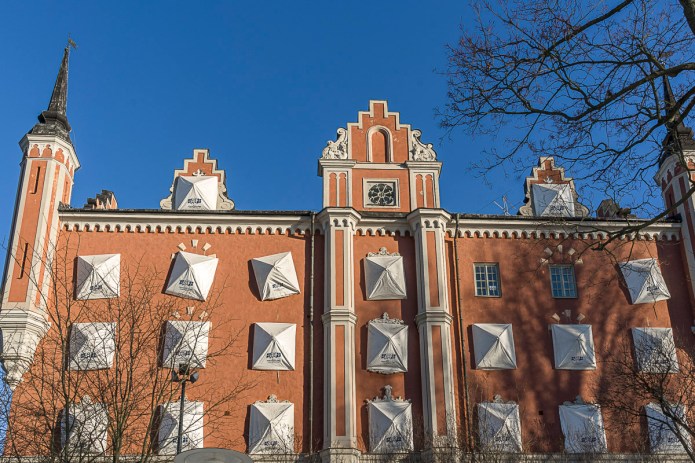
Skeppsholmen’s Admiralty House (Amiralitetshuset) was built in 1647-50 when the Admiralty Board moved over to the small island of Skeppsholmen in central Stockholm. The beautiful copper-coloured building is a pleasant sight as you head onto Skeppsholmen, even with all of its windows well covered during my snowy stay.
It is believed to have been designed by Louis Gillis, a Dutch architect operating in Stockholm, and it was built in a Dutch Renaissance style with stepped gables, much like the present building, but there is almost nothing of that original building left now.
It had a varied life, being used as an archive, a corn stable and barracks and was redesigned in 1844-46 by the architect Fredrik Blom as a Neo-Renaissance building with turrets added on the corners. More recently, it was revived, in 1952, by Rudolf Cronstedt to accommodate the Admiralty again which continued for thirty years. Today it houses the offices of the National Museum.
 A colourful note: the first recorded use of copper as a colour term in English was in 1594, and it is obvious that the light reddish brown colour got its name for its resemblance to the metal. The metal’s name came from the latin cyprium meaning “Cyprus”, where so much of it was mined in antiquity (Cypriots first worked copper in the fourth millennium B.C); the term was simplified to cuprum and then eventually Anglicized as copper.
 Copyright Debbie Smyth, 27 January 2016


 Travel with Intent
What a wonderful example of this colour.
LikeLiked by 1 person
Aside from the luscious colour, that’s an interesting way to insulate the windows for the cold weather.
LikeLiked by 1 person
I’m assuming that’s what it’s for, but it does seem quite extreme. I saw a few apartments with with upper windows covered too.
LikeLiked by 1 person