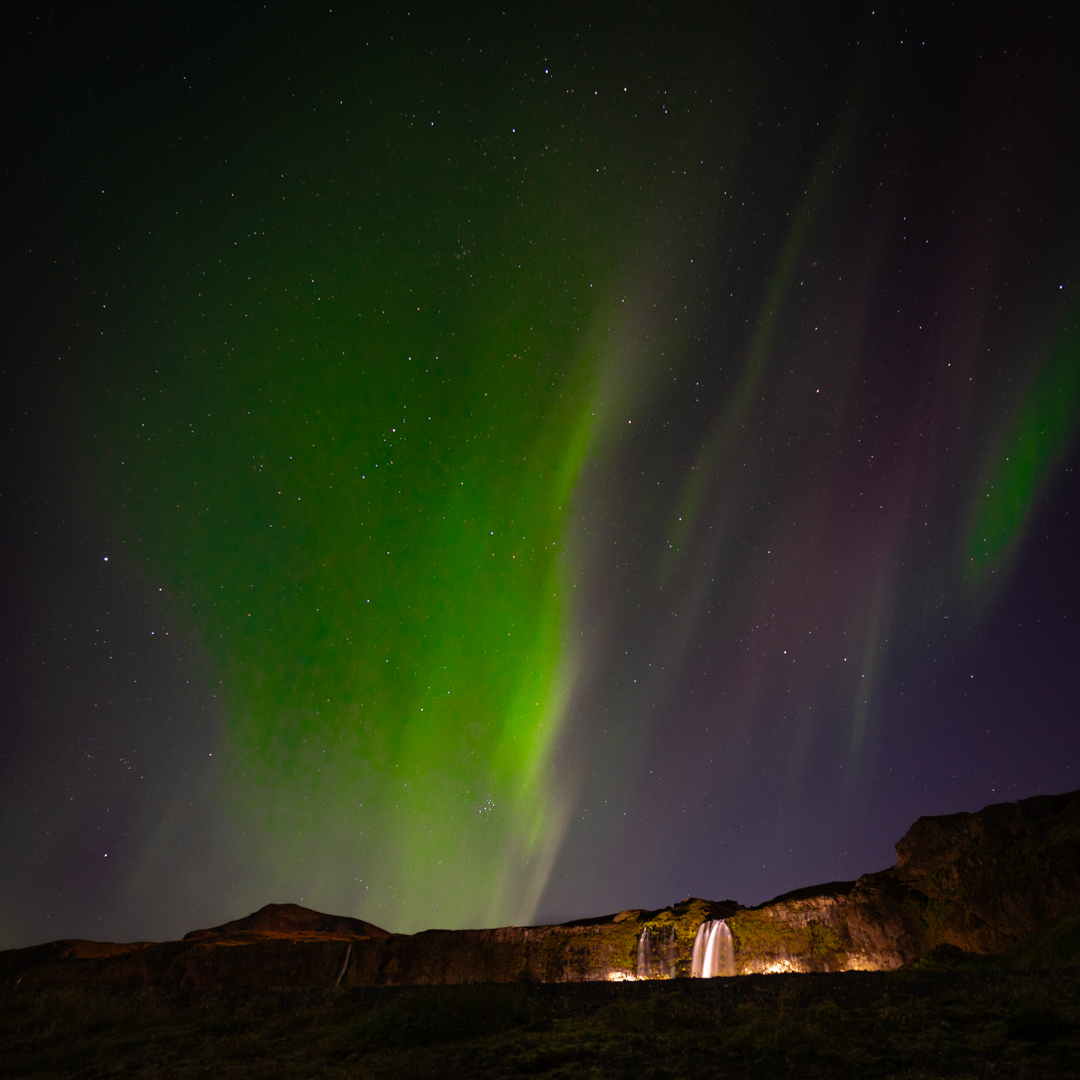
Aurora Borealis in Iceland, September 2018
Some scenes in nature go beyond a standard landscape. They change quickly, behave unpredictably, and don’t always look the way you expect through a viewfinder. They’re visually impressive and they make you work a bit harder as a photographer, which is all part of the appeal.
Here are three natural phenomena that are well worth capturing if you get the chance.
The Aurora Borealis
The Aurora Borealis, also known as the northern lights, never sits still. The shapes shift, the brightness changes, and what you see with your eyes isn’t always what the camera picks up. That’s what makes them interesting to shoot – you’re constantly adjusting the exposure, framing and timing, trying to perfectly capture what’s happening overhead.
It’s tempting to focus only on the sky, but the stronger images usually include something grounded. A simple foreground, whether that’s mountains, fields, a town or the sea, can give the movement above it more context and make the sight even more incredible.
Even when conditions are good, it’s not guaranteed you’ll get the shot you want. But when it works, it really works. For the best chance of capturing the northern lights, head to countries in the Arctic Circle, like Norway or Finland.
Sandstorms and dust-filled skies
Sandstorms change visibility and reshape the entire scene you’re capturing. The light becomes softer, colours shift, and distant objects fade into the background. From a photography standpoint, this can simplify things in a good way – busy landscapes become minimal and strong shapes and silhouettes start to stand out more.
Photographing a sandstorm is less about chasing dramatic light and more about noticing subtle contrast and form. You may find yourself shooting scenes you’d normally ignore.
Of course, conditions can be harsh, so it’s not something to approach casually. But from a safe distance, it can produce images that feel very different from typical landscape work.
There are a number of US national parks that are great for capturing sandstorms, like Death Valley in California. Just make sure to pack responsibly, as conditions in the national park can be harsh even when it’s not windy (July and August are best avoided as the heat becomes oppressive and dangerous).
Bioluminescent waves
Bioluminescence is easy to miss if you’re not looking for it. In the dark, the water suddenly sparkles, with small movements that create flashes of blue light along the shore.
Photographing this phenomenon takes a bit of trial and error. The light is faint, and the effect comes and goes depending on how the water moves. What makes the process rewarding is that the results are never identical. Some frames will show soft, glowing streaks, while others will capture sharper, more defined patterns in the water.
It’s one of those situations where patience matters more than precision. You shoot, adjust, and wait for the right moment. Great places to shoot bioluminescent tides include Mosquito Bay in Puerto Rico and Jervis Bay in New South Wales, Australia.
Know when to press the shutter
When you find yourself in the face of such magnificent but elusive natural beauty, capturing it can be tricky. But doing so preserves your experience so you can look back on it for years to come.
These phenomena aren’t everyday subjects, and that’s exactly why so many photographers are desperate to capture them. Just try to strike the right balance between being present in the moment and knowing when to press the shutter.
Aurora borealis image copyright Debbie Smyth
All text copyright Yasmin Watkins
…


 Travel with Intent