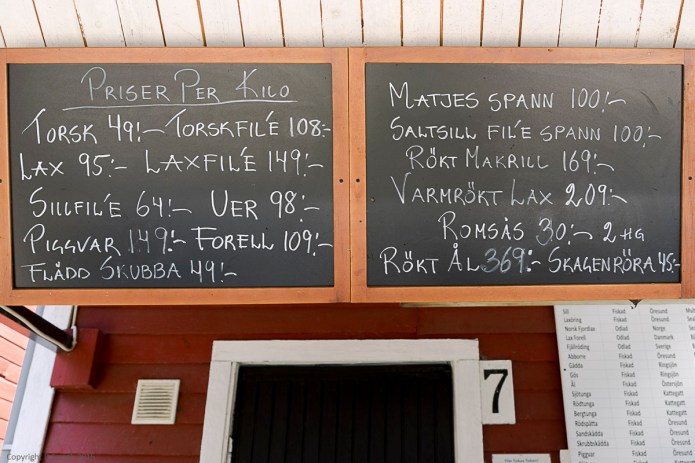
Malmö’s fishing industry has had a long but fluctuating history. The city’s coastal position and plentitude of sandy beaches (it was once named Malmhaug which means sandpile in Swedish) made this an obvious activity and by the 1400s it had a strong herring trade. In fact, archaeological remains show that herring fishing took place as long ago as the 1100s.

Fishing huts were built in the 1800s and developed from small shacks into two-storey, two-room buildings. However, in the mid-1900s the fishing industry declined: importation and the growth of wholesalers made fishing unprofitable for smaller, local fishermen. In the 1950s some fishing huts were donated to the Malmö museum and they were moved to their current location close to the museum.

Fiskehoddorna is now a popular part of Malmö for anyone who likes fish and seafood. It is an active fishmarket using those traditional buildings and offering a good range of fish that has been caught locally by local fishermen.

Fiskehoddorna is open Tuesday to Saturday between 6:30 and 13:00.
Linked to Weight
 Copyright Debbie Smyth, 8 January 2016


 Travel with Intent
Glad to see Malmo is still fishing, I was there back in 2001.
LikeLike
It was great to see
And I loved the city as a whole
LikeLiked by 1 person
Interesting photos and post!
LikeLiked by 1 person
You are indeed a well-travelled lady!!
LikeLike
My job helps ☺
On Fri, Jan 8, 2016 at 9:58 PM, Travel with Intent wrote:
>
LikeLiked by 1 person
Of course!
LikeLiked by 1 person